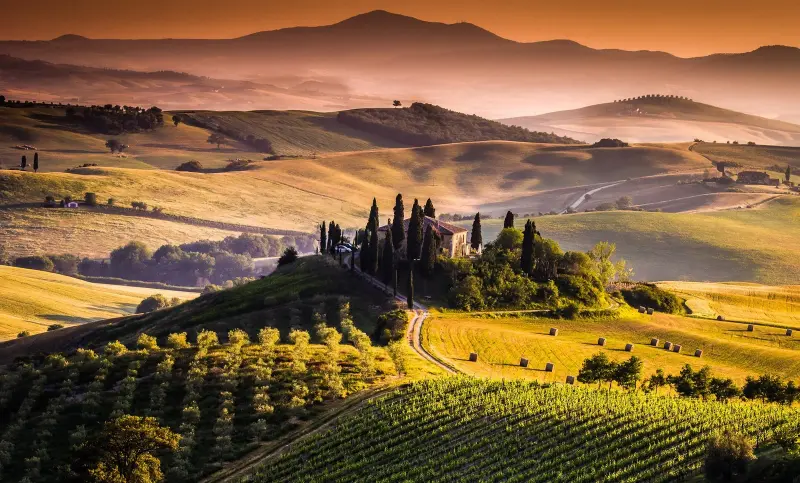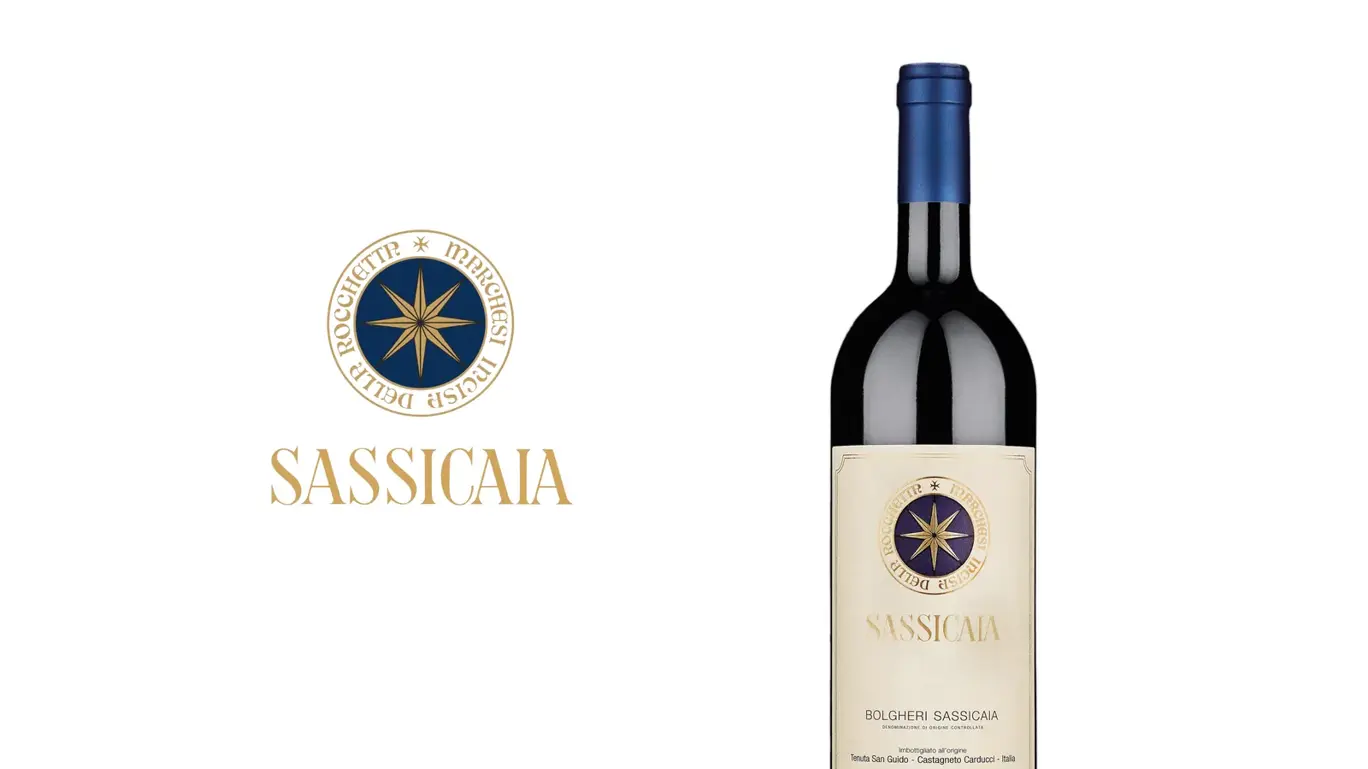
Sassicaia is the wine that changed the idea of Italian red. It was born in Bolgheri, on the Tuscan coast, from a hunch: a Piedmontese marquis believed that stony land could produce a wine to stand alongside the great Bordeaux. Today it is one of the best-known Italian reds in the world, and its denomination has a feature that no other Italian wine has.
In this article
Where it comes from
Sassicaia is produced by Tenuta San Guido, in Bolgheri, in the province of Livorno. The story begins in 1930, when Marchese Mario Incisa della Rocchetta married Clarice della Gherardesca: the estate was part of her dowry. Incisa, from a Piedmontese family and with agricultural studies in Pisa behind him, had long had in mind to make a wine inspired by the Bordeaux he had tasted in his youth.
The name comes from sasso, “stone”: the vineyard soil is rich in stones and gravel, on a base of clay and limestone. A poor soil, which in Tuscany gave no hint of a great wine, and which instead became its strength.
From the family cellar to the market
The first Cabernet Sauvignon vineyards, planted in the 1940s, produced for years a wine meant for the family’s own consumption. The turning point came in the 1960s. The Sassicaia vineyard was planted in 1965 and the first vintage released on the market was 1968, put on sale in the early 1970s.
The meeting with the Antinori family was decisive. Nicolò Incisa della Rocchetta, Mario’s son, is a cousin of Piero Antinori, and thanks to him the oenologist Giacomo Tachis came to the estate. Tachis modernised production, with temperature control during fermentation and the use of barriques. From the 1977 vintage the estate moved to French oak barriques from Tronçais, which clearly improved the quality of the wine even in its youth. Tachis followed Sassicaia until 2010; the oenological direction then passed to Graziana Grassini, who had worked with him for years.
Sassicaia is considered the first of the so-called Super Tuscans, the Tuscan reds outside the rules of the traditional production regulations, which we discuss in our article on what Super Tuscans are and how they came about.
What it is made of
Sassicaia is generally made from about 85% Cabernet Sauvignon and 15% Cabernet Franc, a Bordeaux-style blend aged in barrique. The estate’s vineyards cover about 75 hectares. Alongside Sassicaia, Tenuta San Guido produces two other wines: Guidalberto, introduced in 2000, and Le Difese, since 2002.
The style is that of a structured yet fine red, with a strong ageing capacity. Elegance counts more than power, and this is what over the years has set it apart from many Tuscan wines of a more opulent build.
A denomination of its own
In 1994 the Sassicaia production zone was recognised as a subzone of the new DOC Bolgheri. In 2013 it became an autonomous denomination: the DOC Bolgheri Sassicaia. According to Tenuta San Guido itself, it is the only Italian denomination of origin reserved for a single wine, produced by a single estate, within a clearly delimited vineyard area.
The difference from other DOCs is substantial: as a rule a denomination brings together many producers, whereas here the boundaries of the denomination coincide with those of a single property.
How to read the vintages
Sassicaia is assessed every year by the leading critics, and some vintages have received very high recognition. From our article on critics’ scores we recall that the 2015 was Wine of the Year 2018 for Wine Spectator and that the 2016 received the maximum score from Wine Advocate. The 2023 is among the wines awarded Tre Bicchieri 2027 by Gambero Rosso, which we wrote about here: Tre Bicchieri 2027 and collectable wines.
A score is an opinion on a single vintage, at a specific moment: it does not tell you how long the wine will live or how much you will like it. For older vintages, knowing how they have been stored matters even more. In general, a young Sassicaia needs time; if you want to open one at the table, always ask the seller what stage of development it is at.
What to check before buying a bottle
Sassicaia is a much sought-after wine, and for the older vintages the bottle in front of you matters as much as the label. Before buying, it is worth asking three questions.
Where does it come from? A bottle that comes through the producer, an official distributor or an identifiable merchant has a history that can be reconstructed. A bottle with no documented passages is an unknown.
How was it stored? Stable temperature, little light, bottle lying down. Temperature swings are the main cause of damage to a wine that is twenty years old or more.
What is the bottle like? The level of the wine in the neck, the label, the capsule and the cork say a lot about the state of the wine, even before it is opened.
In our guide on where to buy fine wine you will find a comparison of the different channels and the costs to factor in.
Where to find it on eWibe
In the eWibe Selezione you will find Tenuta San Guido’s Bolgheri Sassicaia in the 2023 and 2011 vintages, at a fixed price with VAT included. The bottles are checked one by one and you can leave them in your eWibe Cellar, in the vault, or have them delivered to your home.
If you are looking for other vintages, see the eWibe Market, where each producer page collects the wines, the vintages and the reference price for the 75 cl bottle, updated every month.
Frequently asked questions
What is the difference between Sassicaia and Bolgheri Sassicaia? Sassicaia is the name of the wine. Bolgheri Sassicaia is the name of the denomination, autonomous since 2013.
Which grapes is it made from? Generally from about 85% Cabernet Sauvignon and 15% Cabernet Franc.
What was the first vintage on the market? The 1968, put on sale in the early 1970s.
Who produces Sassicaia? Tenuta San Guido, in Bolgheri, still owned by the Incisa della Rocchetta family.