From Pol Roger’s first sale in Aÿ in 1849 to the cellars of Épernay: the friendship with Winston Churchill, the cuvée that bears his name and the vintages returned to the cellar after disgorgement.
“The most drinkable address in the world”: this is what Winston Churchill called number 44 Avenue de Champagne in Épernay, the home of Odette Pol-Roger. He drank the Champagne of Pol Roger for over half a century, from the first documented order in 1908 until his death in 1965. In October the maison presented the Édition Vinothèque 2026 in Italy: vintages disgorged at first release and then returned to the cellar for years before being put on sale.
We go back over the history of Pol Roger, from the cellar collapse of 1900 to the friendship with Churchill, the cuvée that bears his name, the style of the wines and the idea behind the Vinothèque. At the end, you will find the Pol Roger bottles available on eWibe and how to drink them.
From Aÿ to Épernay: the origins of Pol Roger
On 2 January 1849, in Aÿ, Pol Roger recorded his first sale of Champagne. He was not yet twenty and was the son of a notary who could no longer practise his profession. In 1851 the family settled in Épernay and from 1855 Pol focused on dry Champagnes, the ones the English market preferred. The first Royal Warrant, the title of supplier to the British Crown, came in 1877 from Queen Victoria.
When he died in 1899, the running of the house passed to his sons Maurice and Georges, who the following year obtained permission to add their father’s name to the surname: from then on the family was called Pol-Roger. 1900 also brought disaster: on 23 February part of the cellars and buildings in rue Henri-Lelarge collapsed, and 1.5 million bottles and 500 casks were lost. The maison then rebuilt its premises on Avenue de Champagne, which German bombing in 1918 severely damaged and which was later restored to the original design.
Some of those bottles came to light only on 15 January 2018, during building work: first about twenty, intact and full, then dozens more, from vintages between 1888 and 1898 according to the ledgers of the time. On 9 October 2019 Francis Mainguet, at the maison since 1990 and a disgorgement specialist, opened the first one, with more than ten minutes of work for each bottle. The bubbles were gone, but a slight prickle remained, and Damien Cambres found in it “great richness and great length”.
Winston Churchill and Odette Pol-Roger
Churchill’s first known order dates from 1908, when he was President of the Board of Trade: a case of Pol Roger 1895, recorded in an invoice from his London merchant. He liked to repeat a phrase that seems to be adapted from Napoleon: “I cannot live without Champagne. In victory I deserve it, in defeat I need it.”
The friendship with the family began in November 1944, in newly liberated Paris: at a lunch at the British Embassy, Ambassador Duff Cooper introduced him to Odette Pol-Roger, who during the war years had in effect taken over the running of the maison and had taken part in the Resistance. From then on, on every birthday, Odette sent him a case of Champagne: after the war mostly the 1928 vintage, for as long as there was any, then the 1934; by 1965 Churchill had started on the 1947.
Churchill returned the gesture in his own way. He named one of his racehorses Pol Roger, which won at Kempton Park in 1953, and he promised Odette several times that he would go to Épernay to “tread the grapes with my feet”, though he never managed it. He then sent her his memoirs with the dedication “Cuvée de Réserve, mise en bouteille au Château de Chartwell”, as if they were a wine bottled at Chartwell, his home in Kent.
In 1965 Odette was among the personal friends invited to the state funeral, in St Paul’s Cathedral. Since then the label of the Brut destined for the United Kingdom has carried a black border, lightened to midnight blue only in 1990. In 2011 Épernay named after Churchill the street where the headquarters stands, which used to be called rue Henri-Lelarge: today the maison is at 1 rue Winston Churchill.
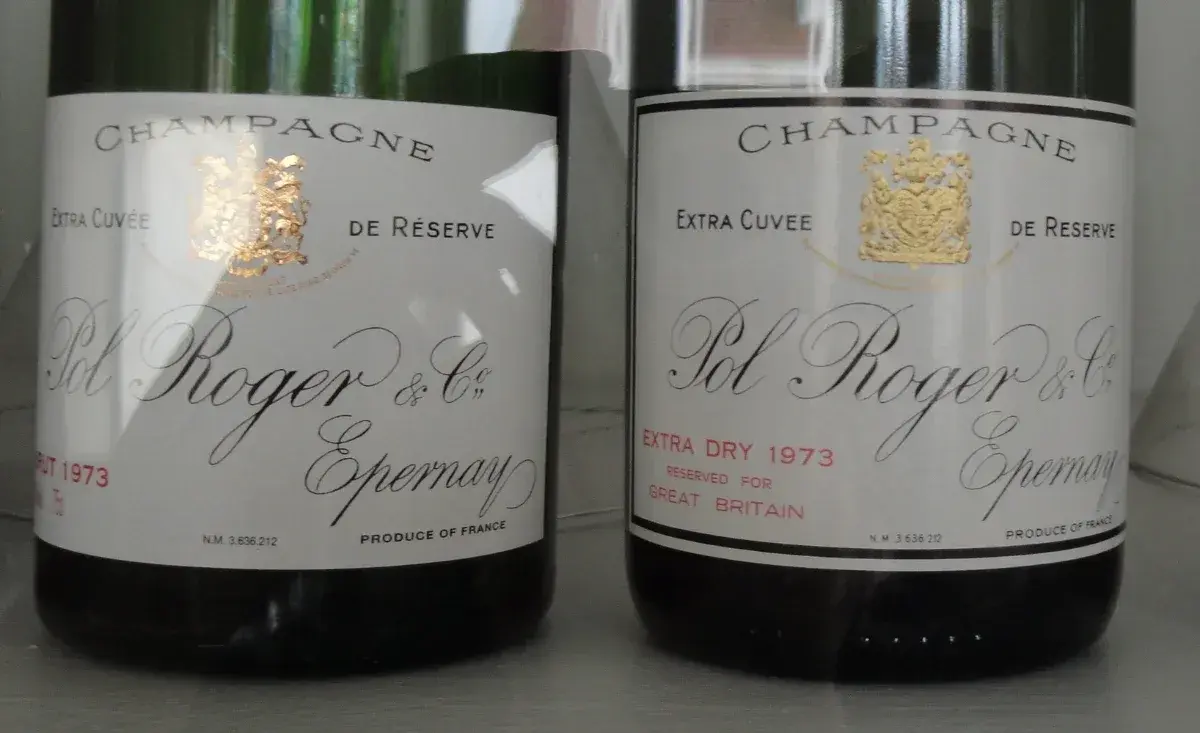
Pol Roger 1973: on the right the bottle for the United Kingdom, with the black border. Photo by Tomas er, CC BY-SA 3.0, via Wikimedia Commons.
The Cuvée Sir Winston Churchill
The cuvée that bears his name was born with the 1975 vintage and was presented in 1984 at Blenheim Palace, where Churchill was born, in magnum only and only in the United Kingdom; the 75 cl bottle arrived with the 1979 vintage. It is the only Champagne cuvée de prestige dedicated to a foreigner, and every vintage is released with the approval of the Churchill family.
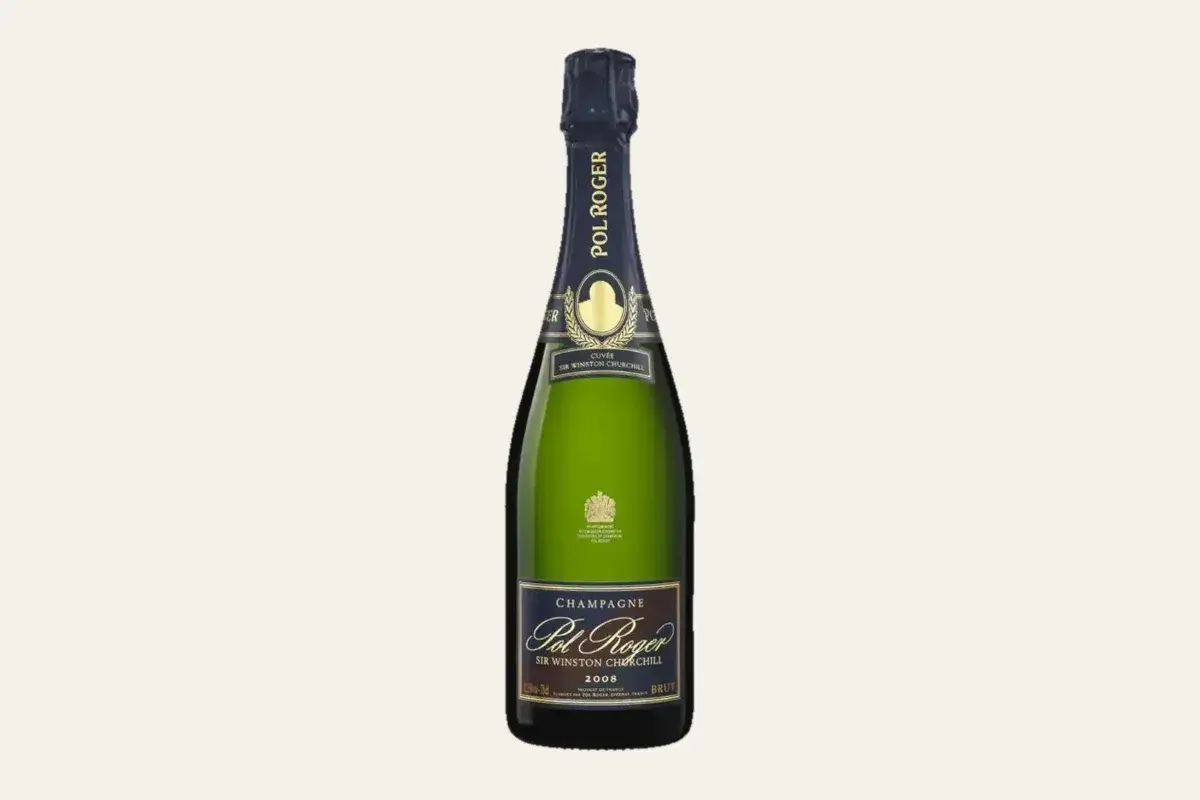
The grapes come only from Grand Cru vineyards of the Montagne de Reims and the Côte des Blancs, classified when Churchill was alive. Pinot Noir always prevails over Chardonnay, but the proportions remain a family secret, and the wine rests about ten years on the lees before disgorgement. “We make the vintage, but in Churchill’s style”, explained Hubert de Billy, fifth generation of the family, to World of Fine Wine. The Champagnes Churchill drank, however, were very different from today’s: aged in wood, darker and sweeter, with 17-25 grams of sugar per litre, whereas the Cuvée Sir Winston Churchill today has a dosage of about 8 g/l.
In the eWibe Market you can currently find the Cuvée Sir Winston Churchill 2015, which received 95/100 from Antonio Galloni (Vinous) and 94+/100 from William Kelley (Wine Advocate).
The maison today: family, cellars and style
The family is still in the business: Hubert de Billy represents the fifth generation and since 2020 Bastien Collard de Billy has joined, the first of the sixth. The chef de caves is Damien Cambres, who in 2018 took over from Dominique Petit, who led the cellar for nineteen years after almost twenty-five at Krug.
The estate’s vineyards, more than 90 hectares, cover about 40% of requirements; the rest comes from about 130 growers and partners. In Épernay the maison has 7.5 kilometres of cellars, dug down to a depth of 33 metres, and every year about 1.5 million bottles are still riddled by hand by some forty remueurs. In April 2024, for its 175th anniversary, it opened a new production site worth 50 million euros, on four levels, as World of Fine Wine reports.
Since 4 July 2015 Avenue de Champagne has been one of the three core areas of the Champagne Hillsides, Houses and Cellars, inscribed on the UNESCO World Heritage List together with the historic coteaux between Cumières and Mareuil-sur-Aÿ and the Saint-Nicaise hill in Reims.
In the cellar the must is settled twice, the second time cold, at 6 °C for 24 hours, and ferments at low temperature in steel; for the Cuvée Sir Winston Churchill, grape varieties and crus are vinified separately until blending. The later stages, from second fermentation to disgorgement, are described in our article on how Champagne is made.
The wines of Pol Roger
Brut Réserve: Pinot Noir, Meunier and Chardonnay in equal parts from 30 crus, with 25% reserve wines and four years in the cellar before disgorgement.
Pure and Rich: the first with zero dosage, the second demi-sec.
Brut Vintage: in 2006, 60% Pinot Noir and 40% Chardonnay from 20 Grands and Premiers Crus.
Blanc de Blancs: Chardonnay only, from the Grands Crus of the Côte des Blancs; the 2004 comes from Oiry, Chouilly, Cramant, Avize and Oger.
Rosé Vintage: the Brut Vintage base with about 15% Pinot Noir from the Montagne de Reims, vinified as a red.
Cuvée Sir Winston Churchill: the top of the range, produced only in declared vintages.
The Édition Vinothèque
For its 175th anniversary, in 2024, Pol Roger changed a habit: until then it had sold only current vintages. With the Édition Vinothèque it puts on sale vintages disgorged at first release and then returned to the cellar, at a depth of 33 metres, where they remained undisturbed for years. The bottles, riddled by hand before disgorgement, are dressed by hand with labels, capsules and neck bands that reproduce those in the archive, and closed in a wooden case.
Keeping a wine in the cellar for ten or fifteen years is “a cost for us and a value for the consumer”, said Laurent d’Harcourt, then chairman of the management board, in 2025. The 2026 edition, presented in Italy in October, brings together four vintages:
Blanc de Blancs 2004, disgorged in October 2014, with a dosage of 8 g/l;
Rosé Vintage 2004, disgorged in April 2013, 9 g/l;
Brut Vintage 2006, disgorged between May and June 2016, 7 g/l;
Cuvée Sir Winston Churchill 2004, disgorged between 2015 and 2016 depending on the format, 9 g/l.
In the glass, the Sir Winston Churchill 2002 from the previous Vinothèque shows an intense gold with coppery highlights, with notes of candied yellow fruit, hazelnut liqueur, fruit jelly and aged cognac; the palate is vinous and full, and Damien Cambres calls it “three-dimensional”, for the way it holds together delicacy, power and length.
Pol Roger on eWibe
In the Selezione you will find the Brut Vintage 2018 and the Blanc de Blancs Vintage 2016, at a fixed price. In the coming days some bottles of the Édition Vinothèque will also be available, in standard format and magnum.
In the Market, on the Pol Roger page, you will find eight vintages of the Cuvée Sir Winston Churchill, from 2002 to 2015, with their market price.
Bottles enter eWibe only from producers, official distributors and certified merchants, never from private collections or auction purchases. They then remain in our vaults, at controlled temperature and humidity, insured for 100% of the purchase price: no handling takes place at any change of ownership, and the bottle leaves only when you request home delivery.
When to drink them
The Brut Vintage 2018 and the Blanc de Blancs Vintage 2016, although already enjoyable, will express their qualities fully after a few more years in bottle, and the Sir Winston Churchill 2015 still asks for patience: Galloni wrote in 2022 that he would not think of opening one any time soon. The Vinothèque vintages, on the other hand, reach the glass with years of rest after disgorgement, the years that buyers usually ask of their own cellar: a great Champagne, after all, is best opened a few years after disgorgement. To keep them in the meantime, read our article on how to store fine wines.
Serve them at 10-12 °C, in a large white wine glass rather than a flûte: with mature vintages, serving them too cold shuts down the tertiary aromas, which are the reason for waiting so many years.
Frequently asked questions
Who founded Pol Roger?
Pol Roger, who recorded his first sale of Champagne in Aÿ on 2 January 1849 and settled in Épernay in 1851. In 1900 his sons Maurice and Georges added their father’s name to the surname, and the family became Pol-Roger.
Why is Pol Roger linked to Winston Churchill?
Churchill drank Pol Roger from 1908, the first documented order, until his death in 1965, and from November 1944 he was a friend of Odette Pol-Roger, who after the war sent him mostly the 1928 vintage, then the 1934 and the 1947. He called her house, at 44 Avenue de Champagne, “the most drinkable address in the world”.
What is the Cuvée Sir Winston Churchill?
It is Pol Roger’s prestige cuvée, born with the 1975 vintage and presented in 1984 at Blenheim Palace. It comes only from Grand Cru vineyards of the Montagne de Reims and the Côte des Blancs, with a majority of Pinot Noir, in proportions that the family does not reveal.
What is the Pol Roger Édition Vinothèque?
It is a selection of vintages disgorged at first release and then returned to the cellars of Épernay, at a depth of 33 metres, for further years of ageing. It began in 2024 for the maison’s 175th anniversary; the 2026 edition comprises Blanc de Blancs 2004, Rosé Vintage 2004, Brut Vintage 2006 and Cuvée Sir Winston Churchill 2004.
Which Pol Roger wines are available on eWibe?
In the Selezione, the Brut Vintage 2018 and the Blanc de Blancs Vintage 2016. In the Market, the Cuvée Sir Winston Churchill in eight vintages, from 2002 to 2015, with the 2015 currently on sale.
The bottles mentioned on eWibe
Cover photo: the Pol Roger headquarters on Avenue de Champagne in Épernay, by Fab5669, CC BY-SA 4.0, via Wikimedia Commons, cropped.